
Why Produce Companies Struggle With Inventory Visibility
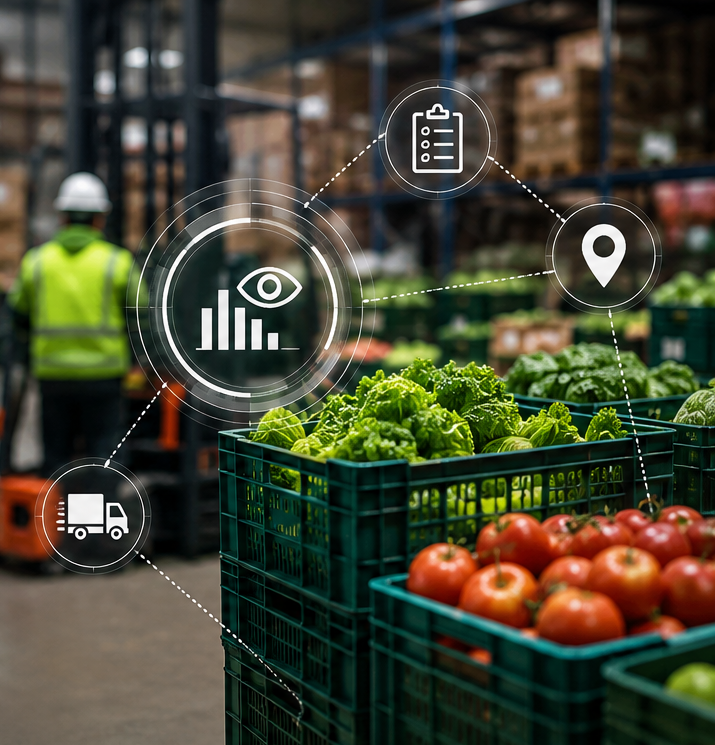
A produce operation is only as strong as the visibility behind it. When inventory changes faster than systems can keep up, teams lose trust, spreadsheets take over, and operational efficiency starts slipping. Here’s why inventory visibility breaks down in produce operations — and what stronger operational alignment actually looks like.
Most produce companies don’t have an inventory problem.
They have a visibility problem.
Because knowing inventory exists somewhere in the system isn’t the same as trusting what the system is telling you.
And in produce operations, trust disappears quickly.
Pallets move before updates take place.
Lots get split and repacked.
Orders change throughout the day.
Inventory gets reallocated.
Supply arrives differently than planned.
Yet many ERP systems still operate as if inventory stays static long enough to keep everything perfectly aligned.
It doesn’t.
So what happens?
Teams stop relying on the system.
They double-check inventory manually.
They walk the warehouse floor before committing product.
They call operations to confirm availability.
They keep spreadsheets open beside the ERP because it feels safer than trusting what’s on screen.
Not because the team is resistant to technology.
Because the operation is moving faster than the system can keep up.
Inventory Visibility Breaks Down Faster Than Most Teams Realize
Most ERP systems can record inventory transactions.
That’s not the hard part.
The hard part is maintaining visibility while inventory is constantly changing in real operational conditions.
Produce inventory is never sitting still long enough for traditional ERP logic to work cleanly.
Pallets are moved.
Inventory is repacked.
Product is substituted.
Orders are adjusted.
Allocations shift.
Partial shipments create additional complexity.
And every operational adjustment creates another opportunity for the system to drift further away from reality.
That’s when confidence starts eroding.
Not all at once.
But gradually.
Until teams begin creating their own parallel processes to compensate.
The Spreadsheet Usually Isn’t the Real Problem
Most spreadsheets inside produce operations weren’t created by accident.
They were created because teams needed answers faster than the ERP could provide them.
So operations build workarounds.
A warehouse tracker.
A shipping sheet.
A repack log.
A planner’s “real inventory” file.
A separate document to track adjustments the system can’t reflect properly.
Over time, the business ends up managing inventory across multiple disconnected sources:
ERP systems
spreadsheets
emails
warehouse notes
whiteboards
team memory
At that point, visibility becomes fragmented.
And once trust in inventory accuracy drops, every decision starts slowing down.
Teams verify before acting.
Inventory gets checked repeatedly.
Data gets re-entered.
The operation becomes reactive instead of controlled.
Why Generic ERP Systems Often Fall Behind in Produce
Most ERP systems weren’t designed for operational variability.
They were designed for structured inventory environments where products remain relatively stable, transactions occur predictably, and processes follow clean linear flows.
Produce operations don’t work that way.
Inventory changes constantly.
Timing affects everything.
Supply variability impacts planning daily.
Operational decisions take place minute-by-minute.
That means inventory visibility depends on far more than transaction speed.
It depends on whether the system can stay operationally aligned while the business is actively moving.
There’s a major difference between a system that records what happened and a system that reflects what’s happening.
That gap is where visibility problems begin.
What Strong Inventory Visibility Actually Looks Like
Strong inventory visibility isn’t created through more reports.
Or more manual checks.
Or more people reconciling information.
It comes from operational alignment across the business.
When ERP systems are built specifically for produce operations, inventory movement, lot tracking, repacking, fulfillment, planning, and warehouse activity remain connected inside one operational process.
That reduces the need for:
spreadsheet tracking
duplicate data entry
manual reconciliation
disconnected workflows
constant inventory verification
The result is more than cleaner inventory data.
It’s operational confidence.
Teams move faster because they trust what they’re seeing.
Planning improves.
Decisions get made earlier.
Problems are identified sooner.
And operations spend less time chasing information across disconnected systems.
Final Thought
Most inventory visibility problems don’t start in the warehouse.
They start when systems can’t keep up with how produce operations actually run.
And once teams stop trusting the system, manual processes start filling the gaps.
That’s when visibility becomes fragmented.
Efficiency drops.
And the ERP slowly becomes a system the business records information into — instead of one the operation truly runs on.
Because in produce operations, visibility isn’t just about seeing inventory.
It’s about trusting the operation behind it.
See how Prophet ERP helps produce operations improve inventory visibility, planning, lot tracking, and operational control in real time.