
Sales Orders Don’t Fail in Produce — Communication Does
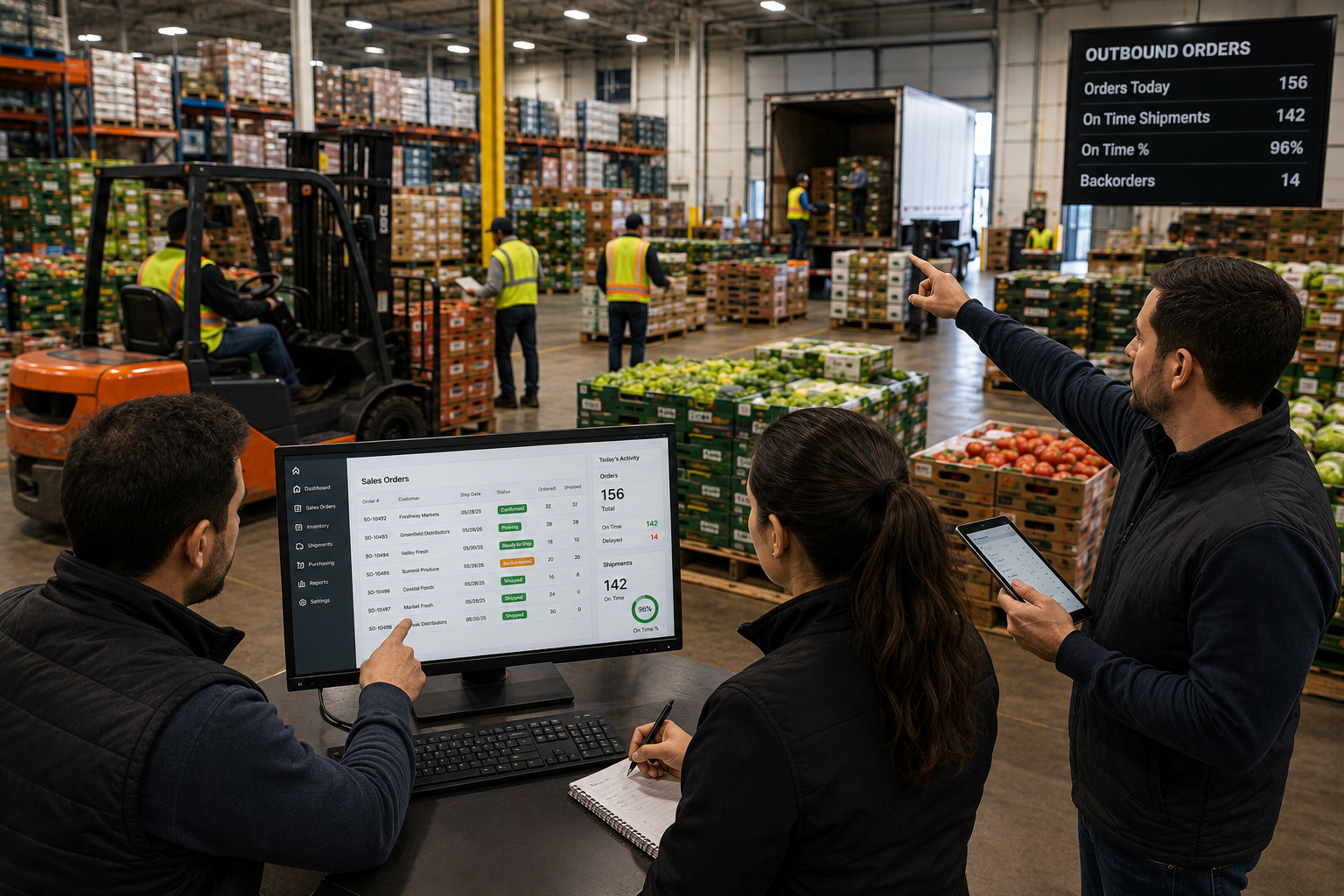
Real-time coordination between sales, warehouse, and operations teams inside a modern produce distribution facility.
Produce orders change constantly.
Customers change quantities
Inbound inventory shifts
Loads arrive late
Quality changes
Allocations move
Priorities change during the day
None of that is unusual in produce operations.
The problem starts when departments stop moving together.
Sales thinks product is available
Warehouse is already repacking it
Planning has reassigned inventory elsewhere
Procurement is waiting on inbound product that hasn’t arrived yet
And suddenly one sales order turns into fifteen internal conversations.
That’s where operations start falling out of sync.
The Problem Usually Isn’t the Order
Produce companies often believe they have an order management problem.
Most don’t.
They have a communication problem created by disconnected systems.
When ERP systems don’t keep teams aligned in real time, every department starts operating slightly differently:
Sales works from one set of information
Warehouse works from another
Planning uses spreadsheets
Procurement tracks updates manually
Operations rely on calls and emails
Eventually nobody fully trusts the system.
That’s when teams start checking everything manually before making decisions.
Produce Operations Change Too Fast for Delayed Information
In many industries, delayed updates are frustrating.
In produce, even small delays create expensive problems.
Because produce inventory is constantly moving:
Product gets reallocated
Loads change
Inventory gets repacked
Orders get split
Product quality varies
Customer priorities shift
If one department updates information late — even by an hour — the entire operation starts reacting instead of operating proactively.
That’s why produce teams often spend their day:
Confirming inventory manually
Rechecking allocations
Calling the warehouse
Updating spreadsheets
Re-keying information
Fixing preventable mistakes
Not because people are failing.
Because the systems aren’t keeping teams aligned.
Why Communication Breakdowns Create Operational Pressure
Most produce teams don’t realise how much operational energy gets wasted chasing alignment.
When departments lose visibility:
Sales becomes hesitant to commit orders
Warehouse teams spend their day reacting to changes
Planning becomes reactive
Customer service pressure increases
Last-minute changes multiply
Teams stop trusting forecasts
Managers spend more time escalating issues
Over time, the operation becomes dependent on people instead of process.
That creates risk.
Because operational success should not rely on specific employees “knowing how everything works.”
It should come from systems that keep teams aligned in real time.
This Is Why Real-Time ERP Matters
“Real-time ERP” has become a popular phrase in software.
But in produce operations, real-time visibility is not a feature.
It’s operational survival.
Real-time ERP means:
Sales sees current availability
Warehouse updates reflect immediately
Allocations stay aligned
Planning reacts faster
Procurement sees shortages earlier
Operations works from one version of reality
That completely changes how operations run.
Instead of constantly correcting information, teams can focus on moving product efficiently.
And that’s where operational control starts improving.
Final Thoughts
Most produce order failures start long before an actual mistake is made.
They happen because disconnected systems create communication gaps between departments.
When teams lose alignment, operations slow down.
Workarounds appear.
Manual checking increases.
And small issues become expensive problems.
Produce operations move too quickly for disconnected ERP workflows.
The companies gaining control today are the ones keeping every department working from the same real-time information.
Because in produce, communication is not separate from operations.
Communication is operations.
See how Prophet ERP connects sales, warehouse, inventory, and planning in real time.