
Most ERP Systems Are Great at Reporting the Problem
They’re just not very good at preventing it.
A customer calls.
An order is late.
Inventory isn't where it should be.
A shipment was allocated incorrectly.
A margin issue appears.
A load leaves with the wrong product.
And suddenly everyone starts investigating.
What happened?
Where did it go wrong?
Who changed it?
When did it happen?
Most ERP systems are very good at helping businesses answer those questions.
After the fact.
The report is there.
The transaction history exists.
The audit trail can be reviewed.
Eventually, someone figures out what happened.
But by then, the problem has already occurred.
The customer has already been affected.
The extra labor has already been spent.
The margin has already been lost.
And the team has already shifted into firefighting mode.
That raises an important question.
Is your ERP helping you run the operation?
Or is it simply helping you understand why things went wrong?
Produce Doesn't Give You Time to Look Backwards
In many industries, reviewing yesterday's information is enough.
Produce doesn't work that way.
Inventory is constantly changing.
Loads arrive differently than expected.
Product quality changes.
Customers modify orders.
Allocations move.
Supply shifts.
Warehouse priorities change throughout the day.
Operations don't have the luxury of waiting for tomorrow's report.
By the time a report tells you there is a problem, the operation has already moved on.
The question isn't:
"What happened?"
The question is:
"What's happening right now?"
Because that's where decisions are made.
That's where profitability is protected.
And that's where operational control either exists or disappears.
When ERP Becomes a Historical Record
Many businesses unknowingly reach a point where their ERP stops being the system that runs the operation.
Instead, it becomes the system that records the operation.
The actual work happens somewhere else.
The warehouse relies on experience.
Planners maintain separate files.
Sales teams make calls to confirm information.
Operations keep side notes.
Procurement tracks changes outside the system.
The ERP gets updated eventually.
But it is no longer driving decisions.
It is documenting them.
And there is a major difference between those two things.
One controls the business.
The other records the outcome.
The Warning Signs Are Usually Easy to Spot
Most produce companies don't wake up one morning and decide to stop trusting their ERP.
It happens gradually.
People start checking information elsewhere.
Spreadsheets become part of daily operations.
Teams ask each other for updates instead of checking the system.
Important decisions depend on specific individuals.
Knowledge becomes tribal.
Workarounds become normal.
Eventually, the ERP remains essential for accounting, reporting, and compliance.
But operationally?
The business is running somewhere else.
That's when growth becomes harder.
Because every additional customer, order, warehouse movement, and inventory adjustment creates more pressure on the people holding everything together.
The Best Produce Operations Don't Wait for Reports
High-performing produce businesses operate differently.
They don't use ERP as a rear-view mirror.
They use it as a windshield.
The system becomes the place where operational decisions are made.
Inventory reflects reality.
Orders stay aligned with availability.
Planning adjusts as conditions change.
Warehouse activity updates immediately.
Procurement sees potential shortages before they become customer issues.
Management gains visibility while there is still time to act.
The result isn't just better information.
It's better timing.
And timing is everything in produce.
The Difference Between Visibility and Control
Many software vendors talk about visibility.
Dashboards.
Reports.
Analytics.
KPIs.
Those things matter.
But visibility alone doesn't improve operations.
A report showing yesterday's problem is still yesterday's problem.
Operational control comes from seeing issues while there is still time to change the outcome.
That is where the biggest difference exists between ERP systems built for reporting and ERP systems built for operations.
One explains what happened.
The other helps prevent it.
A Simple Question Worth Asking
If a major issue occurred in your operation today, how quickly would your team know?
More importantly...
Would your ERP help prevent it?
Or would it simply help explain it afterwards?
Because in produce operations, the businesses gaining the most control aren't the ones with the most reports.
They're the ones with systems that keep pace with reality while the operation is still moving.
That's the difference between reporting the business.
And running it.
Final Thought
Most ERP systems tell you where you've been.
Produce companies need systems that help them decide where to go next.
Because when margins are tight, inventory is moving, and customer expectations continue to rise, knowing what happened yesterday isn't enough.
The businesses that thrive are the ones making better decisions today.
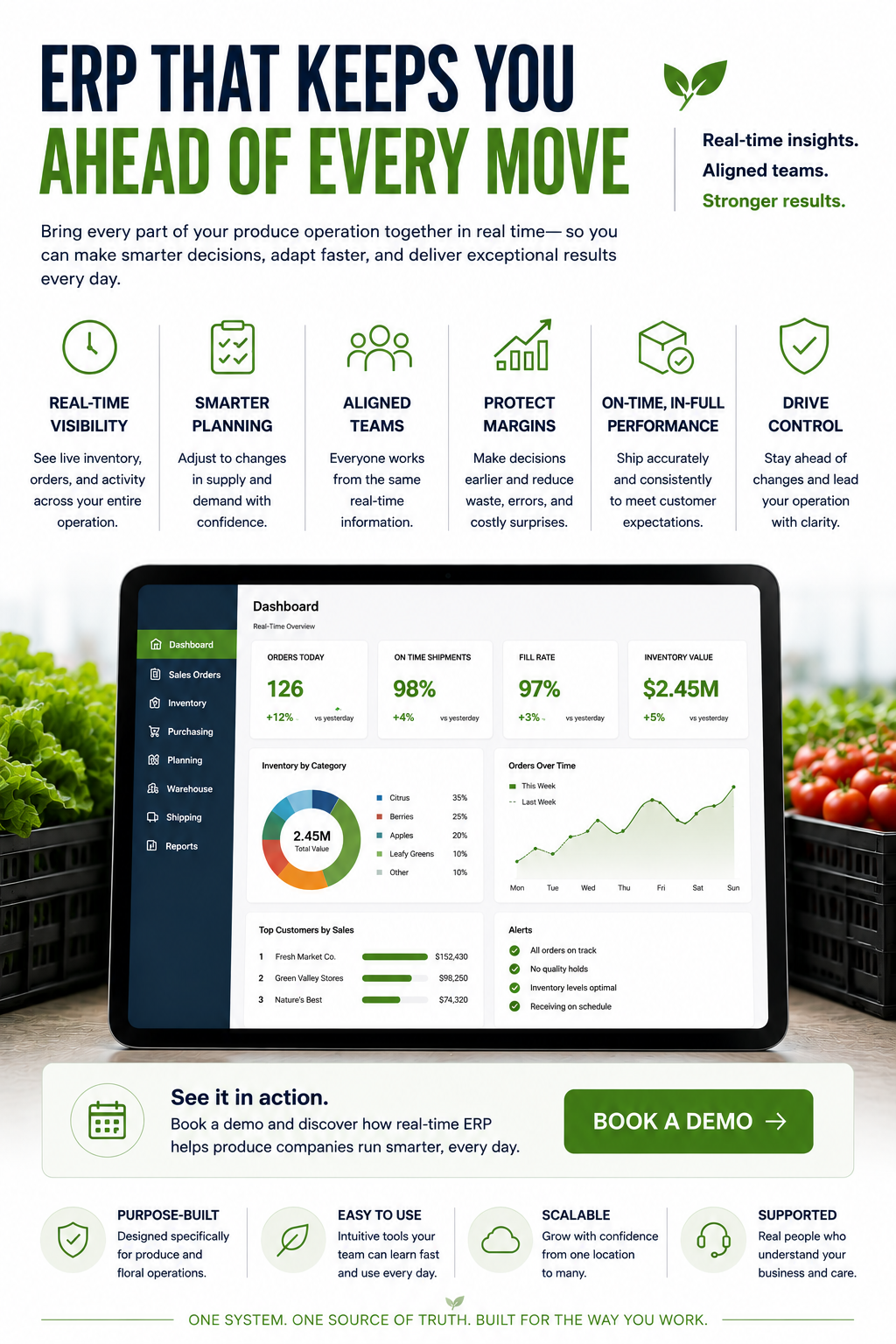
See how Prophet ERP helps produce and floral operations move from reporting problems to preventing them.