
CASE FILE 001
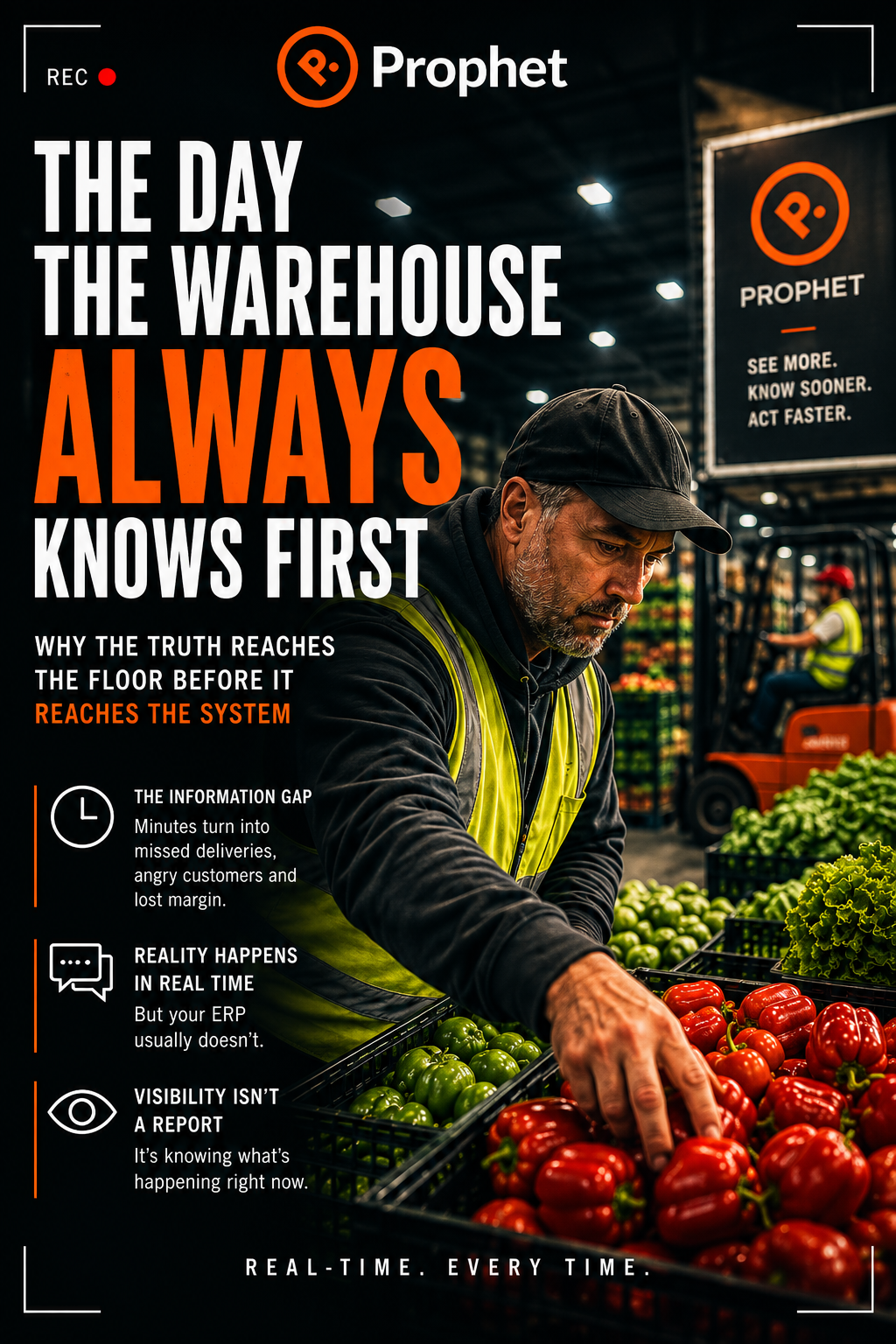
The Day the Warehouse Always Knows First
Why the truth reaches the floor before it reaches the system.
7:42 AM.
A truck arrives earlier than expected.
The warehouse knows within seconds.
Sales won’t know for another 47 minutes.
If you wanted to know what was really happening inside a produce operation...
...you wouldn't walk into the boardroom.
You'd walk into the warehouse.
Because that's where reality arrives first.
Not in a dashboard.
Not in a report.
Not in yesterday's numbers.
On the warehouse floor.
A forklift turns a corner carrying product that wasn't expected until tomorrow.
A pallet arrives short.
A quality inspector quietly pulls aside a shipment that won't make the grade.
An order that was picked an hour ago suddenly needs changing because the customer called.
None of this is unusual.
In produce, it's just another Tuesday.
The interesting part isn't that these things happen.
It's how long it takes everyone else to find out.
Imagine standing in the middle of a busy warehouse.
You don't hear silence.
You hear radios.
Forklifts.
Phone calls.
"Can someone check this lot?"
"That truck just arrived."
"Those avocados aren't good enough."
"Customer changed the order."
"Where's procurement?"
“The warehouse already knows the story. The rest of the business is still reading yesterday’s chapter.”
This is where the information gap begins.
Sales thinks an order is ready.
Planning believes inventory is available.
Procurement is expecting another delivery.
Customer service is reassuring a customer.
Finance is preparing invoices.
Meanwhile...
Someone on the warehouse floor already knows that none of those assumptions are true.
Not because anyone made a mistake.
Because reality changed.
Again.
SCENE TWO
The information starts travelling.
What began on the warehouse floor now starts moving through the business.
☎ Phone call.
💬 Teams message.
📧 Email.
📝 Picking sheet.
📊 Spreadsheet.
💻 ERP update.
Eventually...
Everyone catches up.
Eventually.
But in produce, "eventually" can be expensive.
THE COST OF WAITING
A missed delivery.
A rejected shipment.
An unnecessary credit.
An unhappy customer.
A truck waiting at the dock.
Most operational problems don't start with the warehouse.
They start with information arriving too late.
That's why visibility isn't about reports.
Reports explain what happened.
Visibility tells you what's happening.
There's an important difference.
Knowing yesterday's inventory doesn't help today's picker.
Knowing last night's allocation doesn't help today's customer.
Knowing last week's performance doesn't stop today's problem.
Operational visibility is about giving every department access to the same information at the same time.
Because when everyone sees the same picture, decisions happen faster.
And better decisions are what keep produce moving.
CASE FINDINGS
🟧 Finding 1
The warehouse sees reality first.
🟧 Finding 2
Information doesn't always travel at the same speed.
🟧 Finding 3
The longer information takes to reach the rest of the business, the greater the operational risk.
🟧 Finding 4
Real-time visibility isn't about reporting.
It's about response.
The warehouse will probably always know first.
That's not the problem.
The real question is...
How long does everyone else take to catch up?
The businesses that answer that question well don't eliminate change.
They eliminate the delay between reality and response.
That's where operational advantage is created.
Not by predicting every problem.
But by seeing every problem as soon as it happens.
At Prophet, we believe the best produce businesses aren't the ones with the fewest surprises.
They're the ones where the truth reaches every department as quickly as it reaches the warehouse floor.
Because in produce...
CASE CLOSED
The fastest information usually wins.
— Prophet Investigations
────────────────────────
PROPHET INVESTIGATIONS
A documentary series exploring the operational realities of produce businesses.
────────────────────────
Continue the Investigation
UP NEXT
Most ERP Systems Are Great at Reporting the Problem